EPDM Roofing in Daly City, CA
EPDM Roofing in Daly City
EPDM rubber membrane roofing in Daly City, CA: seam tape and splices, adhered or ballasted installs, repairs, and recover planning for low-slope roofs.
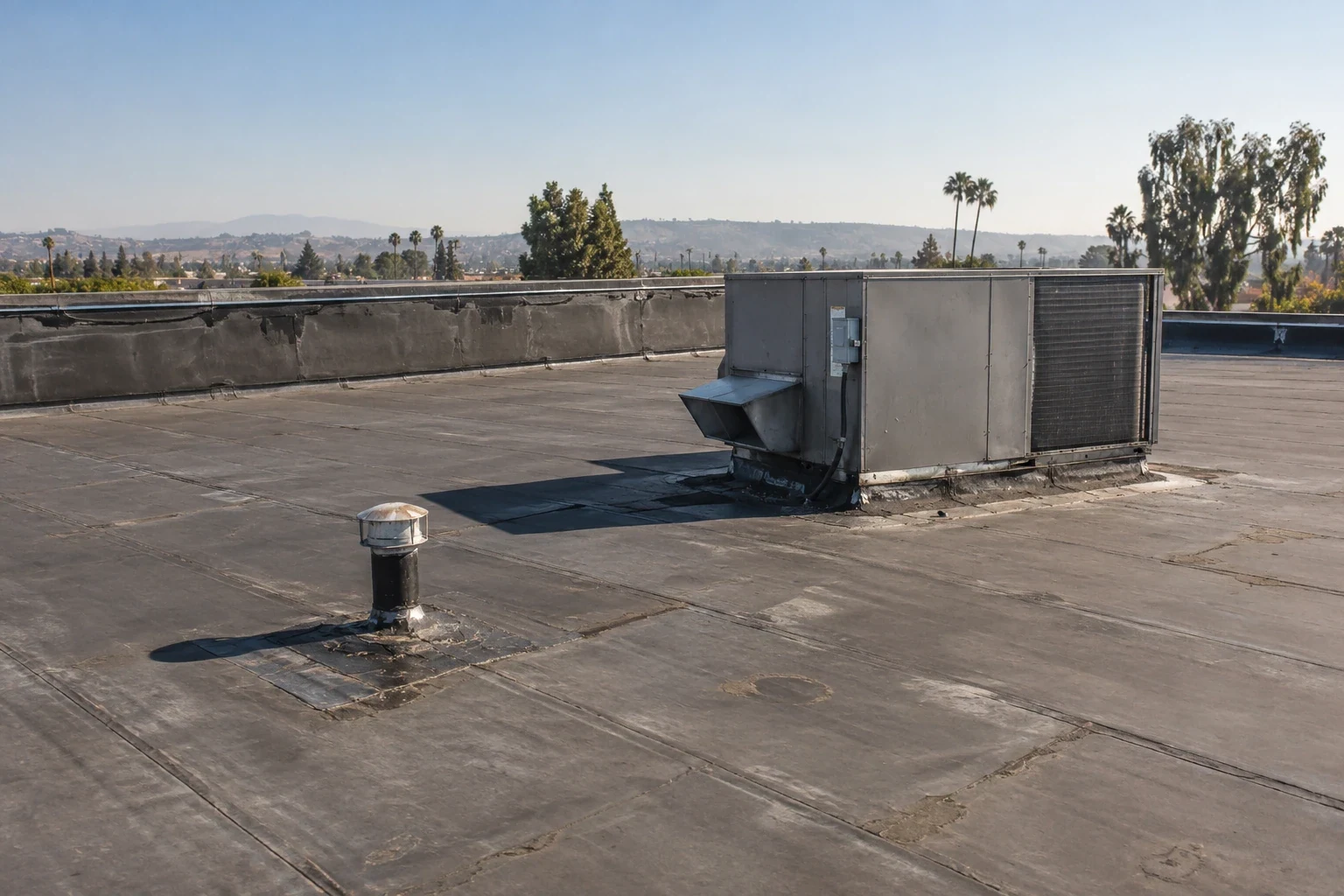
An EPDM roof carries its history in its seams. Black rubber sheet is large, flexible, and forgiving in the field, but each lap, each splice, and each patch is a place where one installer's work meets another's. Before a general contractor commits to a scope on an existing EPDM roof in Daly City, CA, we walk it and count the laps, the repairs, and the terminations, because those details decide whether the membrane is a candidate for repair, a recover, or removal.
Ethylene propylene diene monomer is a cured synthetic rubber sold in wide rolls, which means fewer seams than many other single-ply systems. It is installed fully adhered, mechanically attached, or loose-laid under ballast stone. We repair and install it, and we also advise owners when a different welded membrane makes more sense for the roof they have.
Field condition: Read the laps and the patches
On an aged rubber roof, the first inspection looks at lap edges for lifting, at cut-edge cracking near fasteners, and at the corners where field-formed flashing was shaped by hand. Splice tape that has released at an edge leaves a visible channel where dirt collects. Old repairs stack up too; a roof with a dozen patches of different ages tells us the original sheet may be reaching the end of its serviceable life, even if no single leak looks serious.
We mark every patch and lap on a roof plan and photograph the worst conditions. Moisture checks come next, because rubber membranes can look sound while insulation underneath is wet. The result is a scope that separates repairable areas from ones where it would be wasteful to keep patching. For a facility in the Colma-Daly City BART Station planning area or along Mission Street, that record gives ownership something concrete to carry into a capital discussion.
Install method: Choose adhered, fastened, or ballasted
Fully adhered EPDM uses bonding adhesive to hold the sheet to the substrate, giving a smooth surface that suits roofs with many penetrations and limited weight allowance. Mechanically attached systems use batten bars or plates along seams, which speeds the install but depends on a deck that accepts fasteners. Ballasted systems rely on stone or pavers to hold the membrane in place and require the structure to carry that weight.
The method sets the rest of the sequence. Adhesive work needs dry weather and a clean substrate, so it belongs to a planned access window. Ballast needs staging space for stone, a crane or conveyor, and a protected landing area. We explain which of these the building can accept, and we show the structural question as an item for the engineer of record when the load is unclear, rather than assuming the roof can take it.
Repair or replace: Draw the line with evidence
A single failed seam can be cleaned and re-taped, and a punctured spot can be patched with cured splice material. Those are ordinary commercial roof repairs, and they make sense when the surrounding sheet is flexible and the insulation is dry. When the rubber has hardened, shrunk away from walls, or lost adhesion across large areas, repairs only move the leak.
We put the repair-or-replace decision into the report with photographs and moisture results, plus a ranked list of areas by condition. If the owner chooses repair, we price the repairs and state which ones are temporary. If the owner chooses replacement, we define the tear-off boundary and the new assembly. A recover over the existing layer is another path, and it depends on dry insulation and a deck that can carry a second system.
Wet season: Time the open roof against the station record
At the nearby San Francisco International Airport NOAA station, 16.76 inches of the 19.64-inch annual normal falls from November through March, while June through August total 0.18 inch. That is a station record rather than a Daly City measurement, but it is the reference we use to plan open-roof time. Adhesive and seam tape both need dry surfaces, so the larger EPDM installs fit the summer window.
If work must run into the cool season, the sequence shortens each day's open area and adds temporary tie-ins at every wall and curb. Drains are plugged or screened so debris does not move into the line, and a closure plan goes to the general contractor with the schedule. The goal is a roof that is dry-in at the end of each shift, with no unfinished edge waiting for the next weather window.
Trade handoff: Keep rubber away from solvents and fuel
Rubber sheet reacts badly to petroleum products, so the order of trades matters. Mechanical crews that refill fuel, sealant crews that use solvent-based products, and anyone carrying roofing tar for an adjacent modified bitumen area can damage cured EPDM if the spill reaches the sheet. We place protective mats on the access route, name the staging zone for other trades, and mark the sections that are fresh so no one drags a hose or a cart across an unfinished lap.
When a unit is replaced after the roof is complete, the roofing scope should include a short return visit to inspect and re-flash the curb. That visit is cheaper to plan during the job than to arrange after a leak shows up in a tenant ceiling.
Questions About EPDM Roofing
Cost driver: Count the flashings
The field of an EPDM roof is quick to price. The flashing is where the cost collects: walls, curbs, pipes, scuppers, and expansion joints each take custom pieces. Cover board, insulation thickness, and existing-layer removal also move the number. Access is a factor on roofs reached only through a tenant space or by a lift on a narrow site.
For EPDM work, check the permit date against Daly City’s locally amended 2025 code cycle, effective January 1, 2026. The Building Division handles Title 24 plan review and construction inspection. We keep permit timing in the proposal because it can alter insulation and fire-classification choices. Material and crews reach the area by Interstate 280 and the city's other routes, so delivery windows are written into the sequence along with the rest of the local scope.
Closeout: Hand over the seam and flashing map
When the work is complete, the owner receives photographs of every termination and a marked plan that shows the seams, the repairs, and the drains. If the project was a repair rather than a replacement, the record also lists what was left in place and why. A later condition report can compare against these photographs, and a maintenance visit can inspect the splice areas first.
Commercial Roofing Questions
How long does an EPDM membrane stay serviceable?
Condition matters more than age. We look at seam adhesion, surface cracking, shrinkage at walls, and moisture in the insulation, and then rank the areas for repair or removal.
Can a leak in an EPDM roof be fixed without replacement?
Often, if the sheet is still flexible. We clean the area, apply primer and splice tape or a cured patch, and test the surrounding laps.
Is black rubber a problem for rooftop heat?
A dark sheet absorbs more sun than a white one, though the airport station's 58.7 degree mean annual temperature points to a mild coastal setting. A white EPDM or a reflective coating can be selected if the tenant space needs it.
What does ballast change on a Daly City roof?
Stone adds load, needs staging, and hides the membrane. Where the structure is unknown, an engineer should confirm capacity before we plan on it.
Will EPDM stick to old asphalt?
No, adhesive and asphalt do not bond reliably, so we separate the layers with a slip sheet or cover board and review the existing roof first.
More Commercial Roofing in Daly City
Send photographs and roof records
Share the roof plan, any repair history, and access limits. We will walk the membrane and return a repair or replacement scope with a clear boundary.