
Holcim Elevate Roofing in Daly City, CA
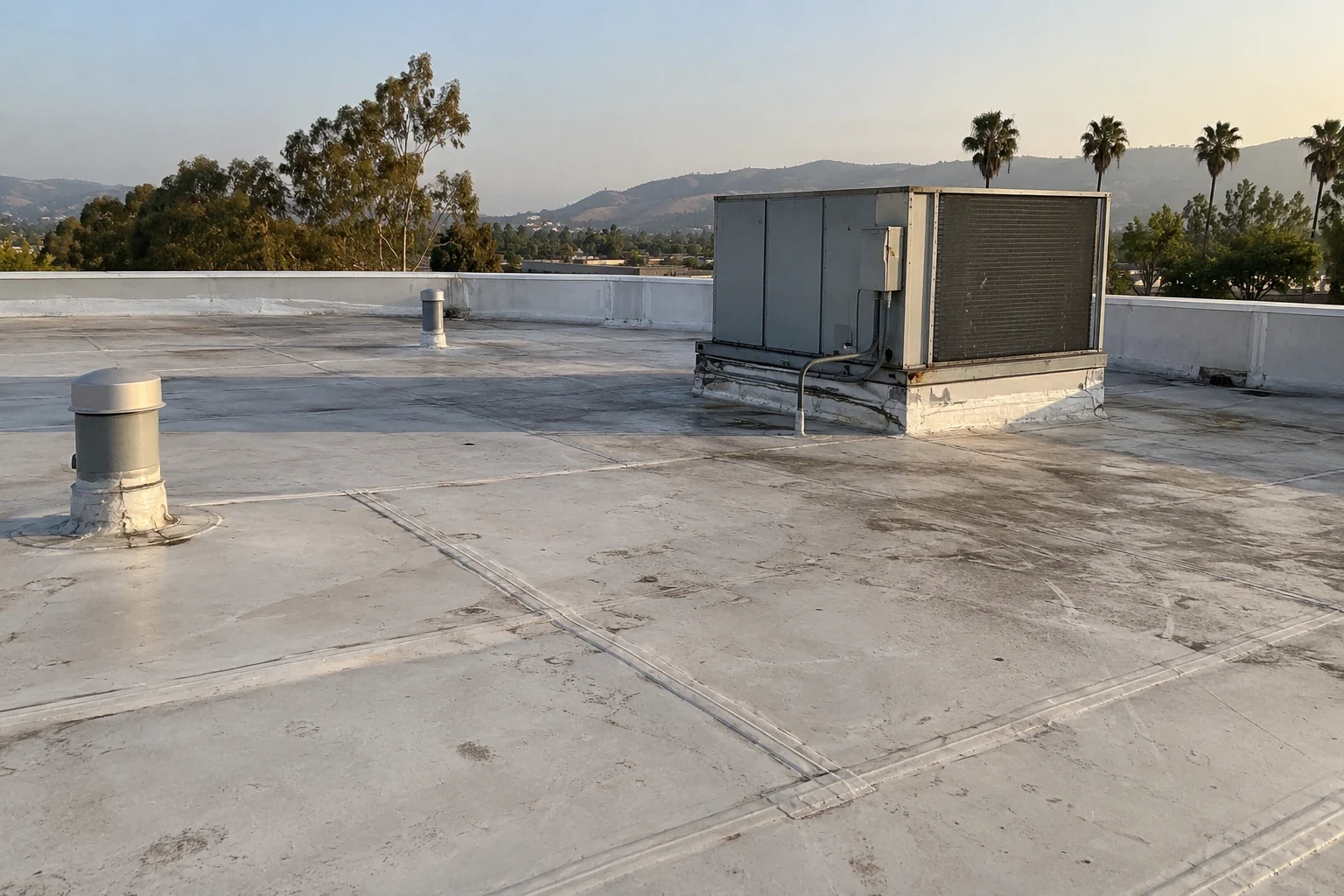
Holcim Elevate Roofing in Daly City
Holcim Elevate roofing in Daly City, CA, formerly Firestone Building Products: UltraPly TPO and RubberGard EPDM installs, repairs, and scope tie-ins.
Older drawings and warranty files for a Daly City, CA project may carry the name Firestone Building Products, and newer specifications carry Holcim Elevate. Both refer to the same line of commercial roofing materials, so a general contractor reading a set of plans may meet either name for what is, on the roof, the same family of sheets. The best-known members are UltraPly TPO and RubberGard EPDM, with companion adhesives, flashings, and insulation boards.
The renaming creates one practical task for a scope: matching the existing roof records to the current product names so the repair material is compatible. A roof installed under the Firestone name can usually be repaired with current Holcim Elevate accessories, but the match should be confirmed against the product data, not assumed from the label. We install and repair these systems and start by identifying what is actually on the roof.
System detail: UltraPly TPO and RubberGard EPDM compared
UltraPly TPO is a heat-welded thermoplastic. Its seams are formed with a hot-air welder, and the white surface reflects sunlight. It tends to be chosen for roofs where the owner wants a bright surface and a continuous weld at every lap. TPO roofing installed over a clean substrate with the right adhesive or fastener pattern performs well, but the weld needs a probe test, because a seam that looks closed can still be open under the surface.
RubberGard EPDM is a cured rubber sheet, black or white, that comes in wide rolls and is joined with splice tape or adhesive. Because the rolls are wide, a large field can be covered with few seams, and field repairs can often be made in cooler weather than a weld would allow. An EPDM roof asks more of the substrate preparation at laps and flashings, where primer and cleaning control the bond.
When an owner is deciding between them, the building's use matters more than brand habit. Heat and solar exposure, rooftop traffic, and the chemicals that may drain onto the roof all push the choice.
Field condition: Identify the existing sheet before ordering
Before a repair or tie-in, we confirm which sheet is on the roof. A small sample is cut from a discreet spot and checked for thickness, color, backing, and whether it is a thermoplastic or a thermoset. That matters because a thermoplastic can be welded to another thermoplastic of the same type, while a thermoset needs adhesive or tape. A mismatch at the tie-in becomes the first place water finds.
Mission Street, Geneva Avenue, Westlake, and Serramonte are the commercial settings Daly City names in its planning documents, and that context helps with access and phasing, though it does not describe any one roof. Commercial roofs of any age tend to collect equipment over time, and each addition leaves a curb, a pipe, or a patch, and each detail was installed by whichever contractor was on the roof that year. We map these details before the membrane is ordered, so the flashing material matches what each one needs and the transitions between old and new work are drawn, not improvised on the roof. Unknown details found after tear-off are priced as agreed unit items.
Work sequence: Open less than you can close by evening
The sequence of a Holcim Elevate reroof starts with rain. The airport NOAA weather station gives a single-station reading instead of a Daly City average, but it is the nearby one that applies. It logs 16.76 of its 19.64 annual inches from November to March and only 0.18 through the summer. So a tear-off in summer can take wider bays, while a winter job should be opened in smaller sections and closed by evening.
At day's end, the exposed edge is sealed with a temporary tie-in, a compatible membrane sealed to the old roof with sealant and sandbagged against wind. The tie-in is written into the plan, with a named owner, and inspected before work begins the next day. Without that line, nobody is responsible for the one detail that matters most overnight.
Other trades appear in the sequence as well. If a mechanical contractor will set a rooftop unit, the curb flashing is completed first, and the unit is landed on protected walk surfaces. Delaying curb work until after the equipment lands makes a poor flashing and a tight working space.
Scope: Recover or tear off, and what the cores decide
Many Firestone-era roofs are good candidates for a recover if the insulation is dry and the deck is sound. A new UltraPly TPO sheet over a cover board can extend the life of the assembly without hauling away the old layers. The decision depends on test cores, a moisture survey, and the clearance available at curbs and walls. If the cores show wet insulation, a recover only seals in a problem, and a tear-off becomes the right scope.
We also check weight. Adding a layer adds dead load, and an older building may have limited reserve. For a recover, the structural capacity is a question for the building's engineer, and we raise it before the order is placed.
Cost driver: Removal, insulation and phasing
The price of a Holcim Elevate roof tracks removal depth, insulation thickness, attachment method, and the number of phases the building allows. A roof over an occupied retail space that keeps its entrances open takes more phases than one over an empty shell. The count of penetrations and the height of the parapets set the flashing labor, and tapered insulation adds both material and layout time.
Code timing applies as well. Since January 1, 2026, Daly City has enforced the 2025 California Building Standards Code with its local amendments, and an application that was complete before that day may proceed under the earlier edition. We confirm which cycle applies to the application, because insulation requirements can change what the assembly looks like.
Any warranty is the manufacturer's to issue, and it follows the approved system and the inspection steps. We list the inspections as scheduled items in the sequence.
Questions About Holcim Elevate Roofing
Closeout: A record that survives the next rebrand
Because product names shift, the closeout record lists what was installed in plain terms: sheet type, thickness, attachment, insulation, and the date. It includes photographs of every termination and penetration. If the manufacturer's name changes again, the file still tells the next roofer what to match. The same record format works for roofs we are asked to look at in Pacifica, San Bruno, and other nearby cities, and it parallels how we close out Carlisle SynTec and Sika Sarnafil scopes.
Commercial Roofing Questions
Is a Firestone roof the same as a Holcim Elevate roof?
The product line carries both names, and older roofs bear the Firestone label. We confirm the sheet type from a sample before choosing repair materials, since compatibility depends on the membrane and not the name.
Can RubberGard EPDM be repaired in cool weather?
Often, yes, because tape and adhesive splices do not depend on welding temperature. The surface still has to be clean and dry, and primer needs time to reach the right tack.
Why probe-test a TPO weld?
A weld can look closed while the lap is only partly fused. A probe run along the edge finds the open spots, and we mark and repair them before the roof is accepted.
What if our records still say Firestone?
Send them anyway. Dates, thickness, and attachment details help us match accessories, and a core sample confirms the rest. The records go into the closeout file next to the new work.
Can an old EPDM field take a TPO recover?
Sometimes, with a separation layer or cover board. Moisture in the insulation and the condition of the deck decide, and cores are the only reliable way to find out.
More Commercial Roofing in Daly City
Send the roof records and the specification
Share any Firestone or Holcim Elevate records, the plans, and your access limits. We will identify the existing sheet, mark the scope, and return a sequence that fits the other trades.