
Sika Sarnafil PVC Roofing in Daly City, CA
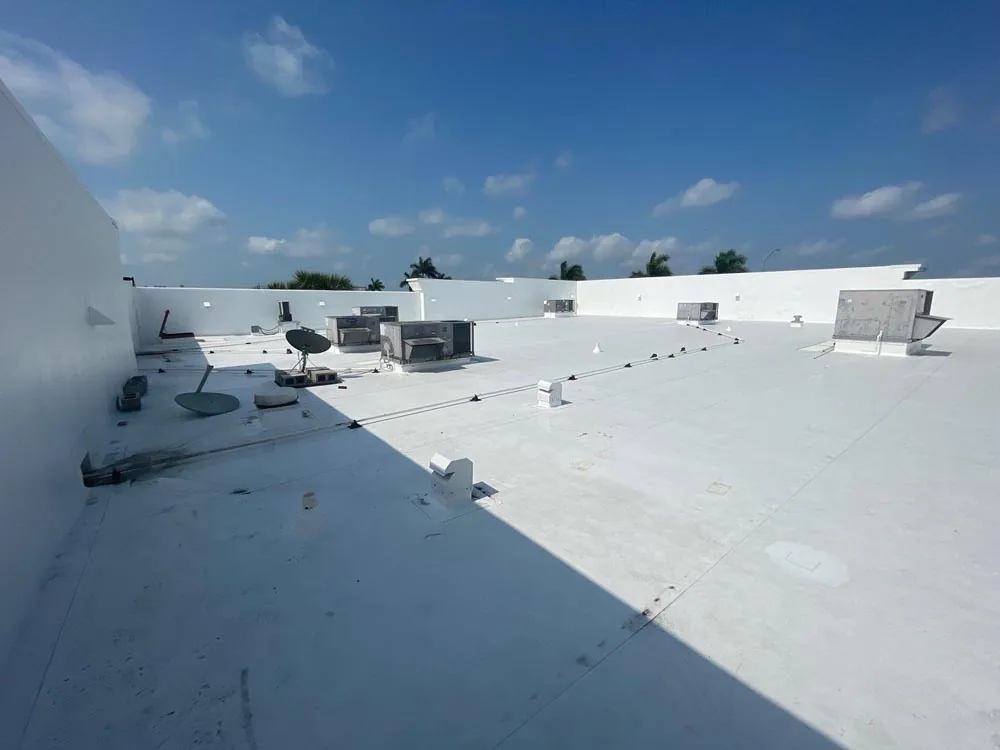
Sika Sarnafil PVC Roofing in Daly City
Sika Sarnafil roofing in Daly City, CA: welded PVC membrane installs, liquid-applied flashing, chemical exposure checks, and the handoff to other trades.
Sarnafil is a welded PVC membrane, and the weld is the point at which a specification becomes a roof. Two sheets are fused with hot air into one piece, and what the owner ends up with is a continuous surface that tolerates a wide range of rooftop conditions. On a Daly City, CA project, the questions that follow are practical ones: what the existing roof is made of, what lands on the new surface, and who has to cross it before the work is closed out.
Sika Sarnafil also supplies liquid-applied flashing resins and metal accessories to go with the sheet. We install and repair PVC roofs, and we read a Sarnafil specification the way a field supervisor would: line by line, against the roof that is actually there, with the details that need a decision marked before the order goes.
Why PVC: Chemical exposure and the welded lap
PVC earns its place where a roof sees exhaust fumes, grease, oils, or other airborne contaminants that attack other membranes. Restaurant kitchens are the common case. South San Francisco's planning materials describe support for biotechnology and the wider business community, and a building with laboratory exhaust raises the same question about what drifts onto the roof. Whether a particular building has any such exposure is something the walk-through settles, not an assumption.
The lap is the other reason. A properly heat-welded PVC lap is fused through its depth. The welder temperature, speed, and nozzle pressure all need to match the day's conditions, which is why a technician makes test welds at the start of each shift and after any pause. Cold, damp, or windy mornings change the settings. Probing along the edge of every seam finds the places where fusion was partial, and those get a cover weld before anyone signs off.
A KEE-based membrane is a close cousin with a different plasticizer package, and the choice between them often turns on how much oil or grease reaches the surface.
Field condition: Compatibility with what is already on the roof
PVC does not tolerate contact with some asphalt-based materials and some older membranes, because plasticizers can migrate. When the new sheet goes over an existing roof, a separation layer or cover board is usually required between them, and the specification should say so. When it does not, we flag it. Westlake, Serramonte, Mission Street, and Geneva Avenue appear in the City's planning materials as commercial settings; that label does not tell us which layers are under any individual roof. Coring does.
The cores tell us how many layers exist, whether the insulation is dry, and what the deck is made of. A steel deck with surface rust may need cleaning and treatment before fasteners go in, and a wood deck needs a check for rot at the edges. We photograph each core and record its location on a roof sketch that goes into the scope.
Trade handoff: Who crosses the new surface, and when
A PVC membrane is easy to damage after it is installed. Dropped tools, rolling carts, and boots with embedded grit leave cuts and scuffs that nobody notices until a leak shows up. Before the roof is released to mechanical, electrical, or solar crews, we lay walk pads along their routes and agree how heavy equipment will be landed. If a unit needs to be set by crane, the curb and flashing are finished first and the landing area is protected.
The handoff includes a penetration rule: any trade that cuts through the roof calls us for the boot or the flashing before they leave. Otherwise a conduit pipe gets a bead of sealant and a promise. A short written line in the scope puts the responsibility where it can be traced.
Rooftop equipment service is the other long-term traffic. Units that need filter changes or belt checks should have a marked walk route from the roof hatch or ladder to each unit, so technicians do not cut new paths across the field. Pads in a contrasting color show the route at a glance, and a quarterly look at their edges tells us whether the traffic has drifted.
Wet season: Welding weather and the rain record
Hot-air welding does not like standing water on a seam. The closest record is the airport NOAA station, a single-station reading that should not be mistaken for a citywide Daly City average. Of its 19.64 inches in a normal year, 16.76 come between November and March; June, July, and August together bring 0.18. We plan new PVC installs for the dry months when possible, and in winter we weld in bays small enough to be dried in the same day.
A roof that must be replaced during the rainy months should have a daily dry-in plan that names the temporary material, the person who checks it, and the shutoff time. Cool, damp mornings also affect adhesives and primers, so we read the manufacturer's data sheets against the actual morning conditions before deciding when to start. A late start costs a few hours of the day, while a weld made on a damp lap can cost the seam.
Cost driver: Sheet thickness, details and access
PVC typically costs more per square than TPO or EPDM, and the thickness of the sheet changes the number again. The details account for most of the labor: wall flashings, curbs, pipe boots, and drains. A building with many penetrations spends more time per square than a clear field. Phasing, lift access, and tenant restrictions add days. The sheet itself is the smaller part of the estimate on a busy roof.
Permits and code cycles also change the scope. Daly City's amended code, the 2025 California Building Standards Code with local changes, became effective on January 1, 2026, and any permit application complete by then can remain under the earlier codes. We confirm the applicable cycle, and we know the City Building Division handles plan review and field inspection, so inspection dates are placed in the sequence.
The manufacturer controls any warranty, and it follows the approved system. We list the required inspections in the schedule and plan the work around them.
Questions About Sika Sarnafil PVC Roofing
Closeout: Weld logs, photographs and a drain test
At closeout we provide photographs of terminations, penetrations, and drains, along with a note of where seams were probed and repaired. We pour water at each drain and watch the flow. For buildings in South San Francisco, Pacifica, and other nearby cities, the same record helps a future owner or lender see what was installed. It also helps the next trade find the roof's limits before cutting into it, much as a Duro-Last or Holcim Elevate closeout does.
Commercial Roofing Questions
Is Sarnafil PVC worth it over TPO?
Where the roof sees grease or chemical exhaust, PVC usually earns the extra cost. On a clean roof, TPO may serve equally well. We look at what lands on the surface before suggesting either.
What does a technician check before welding each day?
A test weld, cut and pulled by hand, confirms the settings. The check repeats after any pause and when the weather shifts. If the test lap peels apart, the settings change.
Can PVC go directly over an old asphalt roof?
Not usually. A separation layer or cover board goes between them, because plasticizer can migrate into asphalt-based materials. The specification should say which, and we raise it when it does not.
How are liquid-applied flashings used with Sarnafil?
They suit odd shapes, such as clustered pipes or irregular curbs, where a cut sheet would leave open seams. The resin cures into a continuous cover that bonds to the prepared surface.
Who fixes a cut made by another trade?
We do, if we are called before the trade leaves. The scope states that every roof cut gets a call, so the repair is made with compatible material and recorded in the file.
More Commercial Roofing in Daly City
Send the plans and the exposure details
Share the specification, the building's rooftop equipment, and any exhaust information. We will walk the roof, check compatibility with the existing layers, and return a PVC scope with a workable sequence.