
Duro-Last Roofing Systems in Daly City, CA
Duro-Last Roofing Systems in Daly City
Duro-Last prefabricated PVC roofing in Daly City, CA: measurements, panel layout, field repairs, and maintenance for low-slope commercial roofs.
A Duro-Last roof begins with a tape measure, because the membrane is cut and welded in a factory to the dimensions of the roof it will cover. Panels arrive labeled, with pipe boots, corners, and curb flashings already formed, and the field crew's job is to lay them out, attach them, and weld the remaining seams. For a Daly City, CA building, that makes the measurement sheet the most important document in the project: an error of a few inches at a parapet or a curb arrives on the roof as a panel that does not fit.
We repair, maintain, and tie into prefabricated PVC roofs, and we work from the manufacturer's published details when a specification calls for them. Made-to-measure work moves the hard decisions to the front of the schedule, where they cost a conversation and not a delay.
Prefabrication: What the factory does and the field finishes
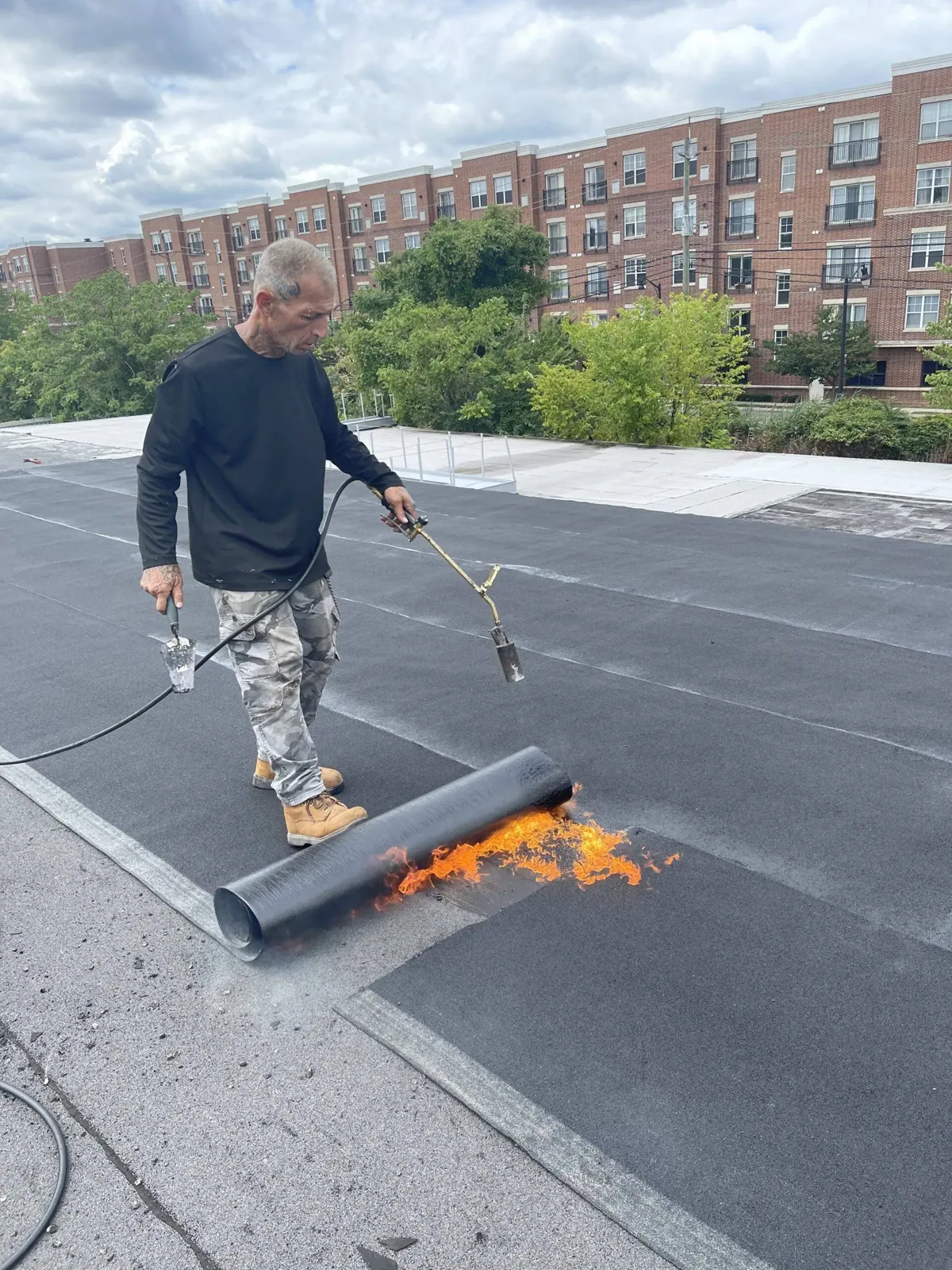
The factory welds large panels from PVC sheet, then forms the accessories that are hardest to build on the roof: pipe boots, inside and outside corners, and wall flashings sized to the project. In the field, those panels are rolled out, attached with a fastening pattern, and joined by hot-air welding at the laps. Fewer field seams means fewer places for the weld technician to get wrong, and the formed accessories reduce guesswork at the details that leak most often.
The tradeoff is lead time and tolerance. A panel cannot be trimmed on the roof as freely as a roll of PVC membrane, so the roof has to be measured carefully and the layout confirmed before the order. Anything changed after measurement, such as a new rooftop unit or a moved drain, becomes a field modification, and those are handled with welded patches and custom boots built from sheet.
Measurement: The sheet that decides whether the panels fit
We measure the roof twice: once for the proposal, and once after the scope is approved and any removal is complete. The measurement records perimeter lengths, parapet heights, curb dimensions, drain locations, pipe diameters, and any change in elevation. Photographs accompany each measurement so the factory can resolve questions without a site visit. If the old roof is torn off, we re-measure the deck, because insulation thickness changes wall heights.
Daly City's planning materials name Westlake, Serramonte, Mission Street, and Geneva Avenue as commercial settings, and on a commercial building of any age equipment accumulates over the years. A rooftop unit set last year will not appear on an older drawing. The walk-through catches it, and the measurement sheet shows it, so the factory builds the right boot.
Deck condition is recorded at the same visit. Where the old roof will be removed, we probe the deck at fastener lines and at the edges, because a panel is only as secure as the substrate that holds its fasteners. Soft spots, rust, and rot are mapped on the sketch with approximate areas, and the repair is priced as a unit item before the order is released, so the owner is not choosing between a delay and a surprise.
Scope boundary: Tie-ins, repairs and the part of the roof that stays
Repairs and tie-ins are a large share of the work on any prefabricated roof. A penetration added after the original install needs a boot welded into the existing field, and the weld depends on whether the surface is clean and the membrane is still weldable. Older PVC can lose plasticizer over time and become harder to fuse, so we test a small area first. If the test weld peels, the repair needs a different approach, such as a cover patch with a compatible adhesive or a liquid-applied flashing resin.
Where a section of an existing roof is replaced, the tie-in between old and new is drawn. We mark the limit of removal on the roof, specify the transition material, and describe how the edge will be sealed overnight. The idea is to leave a boundary that the next roofer can read from the drawing instead of discovering from the leak. For leaks that appear between visits, a leak repair starts by tracing the water to the real entry.
Sequence: Panels in, details closed, bay sealed
Installation moves in bays. Old roofing in the bay is removed, the deck is inspected, insulation goes down, and the panels are laid and attached. Weld technicians then fuse the laps, and the formed accessories are set at penetrations and walls. Each bay is closed before the crew leaves, with a temporary tie-in where it meets the open roof.
The weather matters. Rain is the schedule's biggest outside variable. The San Francisco International Airport weather station (a station record, not a citywide Daly City figure) puts most of its yearly 19.64 inches, 16.76, in the November to March stretch, with a mere 0.18 inches across the three summer months. Large prefabricated panels are harder to protect than small sheets if rain arrives mid-install, so winter work uses smaller bays and shorter lead-in times.
Other trades fit into the sequence at defined points. When a unit is coming, the curb gets its formed accessory first and the unit lands on protected pads afterward.
Cost driver: Measurement, lead time and details
A prefabricated roof carries a cost for the measurement and fabrication step, and it saves some field labor. The estimate follows roof size and shape, the number of formed accessories, insulation thickness, and the difficulty of access. Time is part of the price as well: panels need lead time, so an emergency replacement may need a different system or a temporary repair while the order is built.
Code timing also matters. Daly City moved to the 2025 California Building Standards Code, with local amendments, on January 1, 2026, and a permit file that was already complete before then can keep the code it was filed under. The City Building Division performs plan review and field inspections, so the schedule includes those steps.
The manufacturer sets any warranty terms, which follow the approved system and the inspection process. We write the requirements into the schedule.
Questions About Duro-Last Roofing Systems
Closeout: Panel map and the maintenance rhythm
The record includes a panel map showing where each factory piece sits, the locations of field welds, and the boots and flashings added in the field. Photographs cover the terminations and drains. Pairing that map with a routine maintenance visit lets us look at the same seams and boots each season and spot early signs of trouble before the rain starts. The format works for roofs in Daly City, San Bruno, and nearby cities, and parallels how we document Sika Sarnafil and Versico work.
Commercial Roofing Questions
What happens if the measurements are off?
A panel that does not fit is modified in the field with welded patches or reformed accessories, or reordered. That is why we re-measure after tear-off and check the sheet against the deck before the order is released.
Can an older prefabricated roof still be welded for repairs?
Often, after cleaning. Aged PVC can resist fusion, so we run a test weld on a small area first. If it peels, we choose a cover patch or a liquid-applied detail.
Who handles a new pipe cut through the roof?
Whoever cuts it should call us first. We supply and weld a boot, or build a custom one from sheet, and record it on the panel map so the penetration is not forgotten.
Are prefabricated roofs faster to install?
In the field, usually, because most welding is done at the factory. Lead time for fabrication adds days before the crew arrives, so the schedule starts at the order date.
How does the rainy season affect panel installation?
Large panels are harder to cover in a sudden storm, so winter jobs use smaller bays and quick dry-ins. We schedule weather days and watch the forecast before opening new area.
More Commercial Roofing in Daly City
Send the roof records and the measurement questions
Share any existing Duro-Last records, plans, and access limits. We will walk the roof, measure the details that matter, and return a scope with the tie-ins and sequence marked.