
Soprema Roofing Systems in Daly City, CA
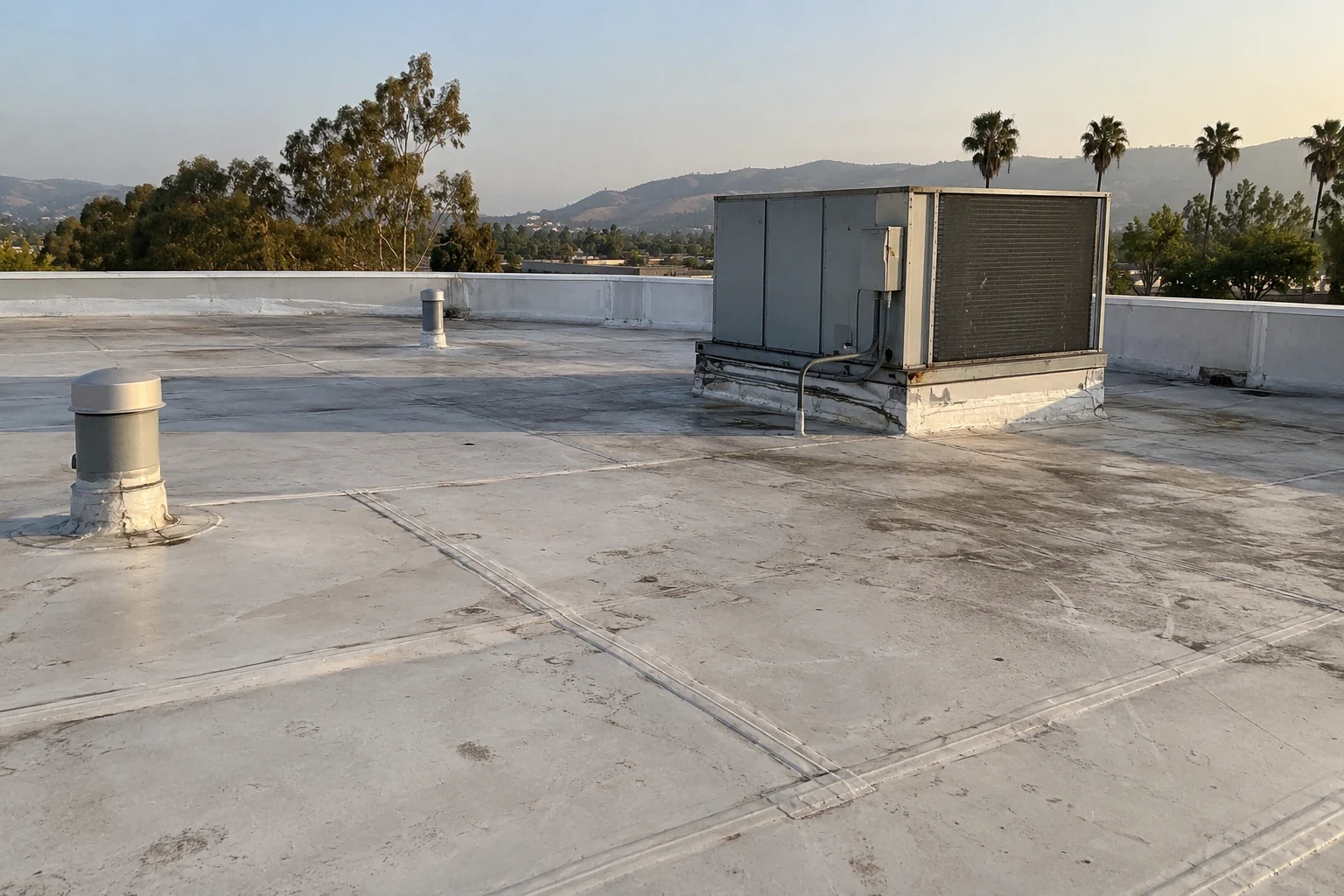
Soprema Roofing Systems in Daly City
Soprema roofing in Daly City, CA: Sopralene modified bitumen, Alsan liquid-applied flashing, and polyiso insulation scopes planned around the wet season.
The detail that gives a Soprema roof its character is often the smallest one: a liquid-applied resin poured around a cluster of pipes where a cut sheet would leave open seams. Soprema is known for Sopralene modified bitumen sheets, Alsan liquid-applied flashing resins, and Sopra-ISO polyiso boards, and a specification that names the manufacturer is usually asking for those pieces to work as one assembly. For a Daly City, CA project, the work is to confirm that the assembly fits the roof deck, the rooftop equipment, and the schedule.
We install and repair modified bitumen roofs and the liquid-applied details that go with them. A specification that mixes sheets and resins needs a sequence that lets each product cure and be inspected before the next one covers it, and that sequence is the first thing we draw.
Sheets and resins: Sopralene plus the Alsan details
Sopralene is a polymer-modified bitumen sheet, installed in two or more layers. The base sheet is fastened or adhered, and the cap sheet carries a granule or mineral surface that takes sun and foot traffic. Sopralene Flam is torch-applied, and Sopralene Stick is self-adhered, so an owner who cannot allow open flame still has a route to the same modified bitumen assembly. Two layers mean redundancy: a nick in the cap does not necessarily open the roof.
Alsan is a liquid-applied resin used around penetrations, drains, and other awkward geometry. Applied properly, it cures into a joint-free boot that follows the shape of the object. Because it is reinforced with fabric and applied in measured coats, the thickness must be tracked, and the coats need the right cure time between them. A rushed second coat on a damp morning is a common failure.
Liquid details work well at skylight and penetration flashing, where a prefabricated boot cannot fit. They are not a replacement for a sound deck or a correct slope.
Scope boundary: Where sheet ends and resin begins
A mixed-product detail needs a drawing. We mark the line where the sheet terminates and the resin begins, indicate the primer used on each surface, and note the cure time before traffic or the next layer. At a rooftop unit curb, for example, the sheet turns up the side and terminates under counterflashing, and the resin closes the corners and the junction with the pipe chase. That junction is a classic leak point because it sits where three surfaces meet.
We also mark the limit of removal on the existing roof, and the point at which the new work ties into any section that remains. If the old section is a different material, the tie-in is a designed detail with compatible products, not a bead of sealant.
The tie-in also sets the order of trades. A roofer cannot finish the resin at a unit curb until the mechanical contractor has set the unit and made the pipe chase final, and the mechanical contractor cannot set the unit until the curb is dry. We write that order on the sequence sheet with a date range for each step, so a late delivery on one side shows up as a visible gap and not as a rushed detail on the last afternoon.
Wet season: Cure times and the November to March window
Resins and primers care about moisture more than sheets do. The rain record we use is the NOAA station at San Francisco International Airport, a record from one station rather than a citywide figure. It averages 16.76 of its 19.64 yearly inches in the November to March window and 0.18 inches over the summer. We therefore try to place liquid-applied work in the dry months, when primers flash off properly and coats cure on schedule.
If a leak forces work in winter, we use tents or covers over the curing area, check surface moisture with a meter, and wait for a workable window. The sequence may include a temporary roof over the area until the resin has cured. The cost of a delayed day is small compared with the cost of redoing a boot that was applied to a damp substrate.
Insulation: The board under the sheet sets the heights
Sopra-ISO and other polyiso boards are installed in staggered layers, fastened or adhered, then covered with a cover board where the system calls for it. The total thickness changes every height on the roof: parapet flashing, curbs, door thresholds, and drain sumps. Before the order, we measure each and decide whether the added thickness fits. Where it does not, a design change such as a raised curb or a modified threshold detail is far cheaper on paper than on the roof. The insulation and cover board package is therefore one of the first decisions in a Soprema scope.
In Daly City, the Mission Street and Geneva Avenue corridors and the Westlake and Serramonte areas are named as commercial settings in the City's planning material. That context supports planning for phased work and access, but each roof is confirmed by coring.
Cost driver: Layers, resins and labor hours
Two-layer assemblies take more labor than single-ply, and the time grows with every liquid detail, since each coat needs its own cure interval. The number of penetrations, the height of parapets, and the amount of tapered insulation drive the estimate. Torch-applied work adds fire watch hours, while self-adhered sheet needs workable temperatures. Access to the roof changes how much material can be staged.
Code timing is a scheduling item: Daly City's amended 2025 California Building Standards Code took effect January 1, 2026, and an application complete before that date may be reviewed under the code it was filed under. The City's Building Division handles plan review and field inspection, and we put those dates in the schedule.
Any manufacturer warranty depends on the approved system and its inspections. We list the required steps so the work stays eligible for whatever the manufacturer issues.
Questions About Soprema Roofing Systems
Closeout: Layer log, coat thickness and drain flow
The record we leave lists layers installed, the cap type, resin coats applied with their dates, and the insulation thickness. It includes photographs by roof area and a drain flow check. The same format applies to roofs in Daly City, San Francisco, and Pacifica, where Highway 1 and the district centers are the commercial areas the city names. It lines up with the way we close out Johns Manville and Holcim Elevate modified bitumen work, so an owner with several buildings can compare them.
Commercial Roofing Questions
What is the advantage of a liquid-applied boot over a prefabricated one?
It fits odd shapes, such as clustered pipes or irregular curbs, without open seams. A prefabricated boot works well on a single round pipe, but a resin boot follows any outline.
Does Sopralene Stick need a torch?
No. It is self-adhered and needs a substrate that is clean, primed, and dry, and weather inside the manufacturer's listed range. That makes it a fit for occupied buildings where open flame is restricted.
How long before foot traffic is allowed on a resin detail?
After the manufacturer's cure time, which depends on temperature and humidity. We tape off the area, put the time on the roof plan, and lay a walk path around it so trades know where not to step.
Can resin details tie into an old roof of another material?
Often yes, if the surface is clean and the primer matches. We test adhesion on a sample before the full detail is poured, since a failed bond appears only after the coat has cured.
What happens to wet insulation found during tear-off?
It comes out, and the area is priced at the unit rate set before the job. Leaving wet board under a new sheet traps moisture and shortens the roof's life.
More Commercial Roofing in Daly City
Send the assembly and the equipment layout
Share the Soprema specification, the plans, and the rooftop equipment list. We will walk the roof, mark where sheet and resin meet, and return a sequence the other trades can plan.