
Commercial Roofing for Auto Dealerships in Daly City, CA
Auto Dealerships in Daly City
Coordinate dealership roof inspections, leak repairs, maintenance, and replacement in Daly City around showroom hours, service bays, and vehicle access.
A dealership roof job touches showroom hours, customer parking, vehicle deliveries, parts movement, and service-bay work at once, so the roof sequence is settled with the operator before the first lift is placed. In Daly City, CA, we start from the property layout: where the crew enters, where materials stage, and which doors or lanes must stay open. Then we review the roof areas and details that need attention and write the work boundary, so the operator can give staff notice instead of reacting to a route change on the day.
We confirm the assembly and the affected areas on site, explain what the inspection shows and what remains uncertain, and keep the agreed access route and operating areas clear while roofing work proceeds.
Sequence: Keep customer and service traffic moving
Dealership activity is spread across different zones. The owner may need an entrance open for customers, an unobstructed path for vehicle movement, and a separate route for parts or service staff. We map the crew access and material staging with the site contact before work starts. If equipment or a lift will cross an active drive, the contact can set the needed time window and communication plan.
Roof work can be divided by area when the weather-protection and tie-in details support a defined daily boundary. We identify which doors, bays, or parking areas may be affected and review the plan for temporary protection below the work. The operator can then give staff a clear notice instead of responding to a route change after the crew arrives.
Findings: Connect the leak to a roof detail
Water visible near a service bay or showroom does not establish where the roof has failed. We inspect the accessible membrane or panels, seams, edges, curbs, penetrations, and drainage points, then document conditions and limitations. The facility team can point out the location and timing of interior observations, recent repairs, and areas where equipment or ceilings restrict access.
If the inspection identifies a localized detail, a commercial leak repair may address the immediate issue. Broader or repeating conditions call for a wider evaluation before the owner chooses a scope. Our roof inspection service records observed conditions, while a condition report can help the facilities lead prioritize follow-up across the property.
Details: Review penetrations and transitions
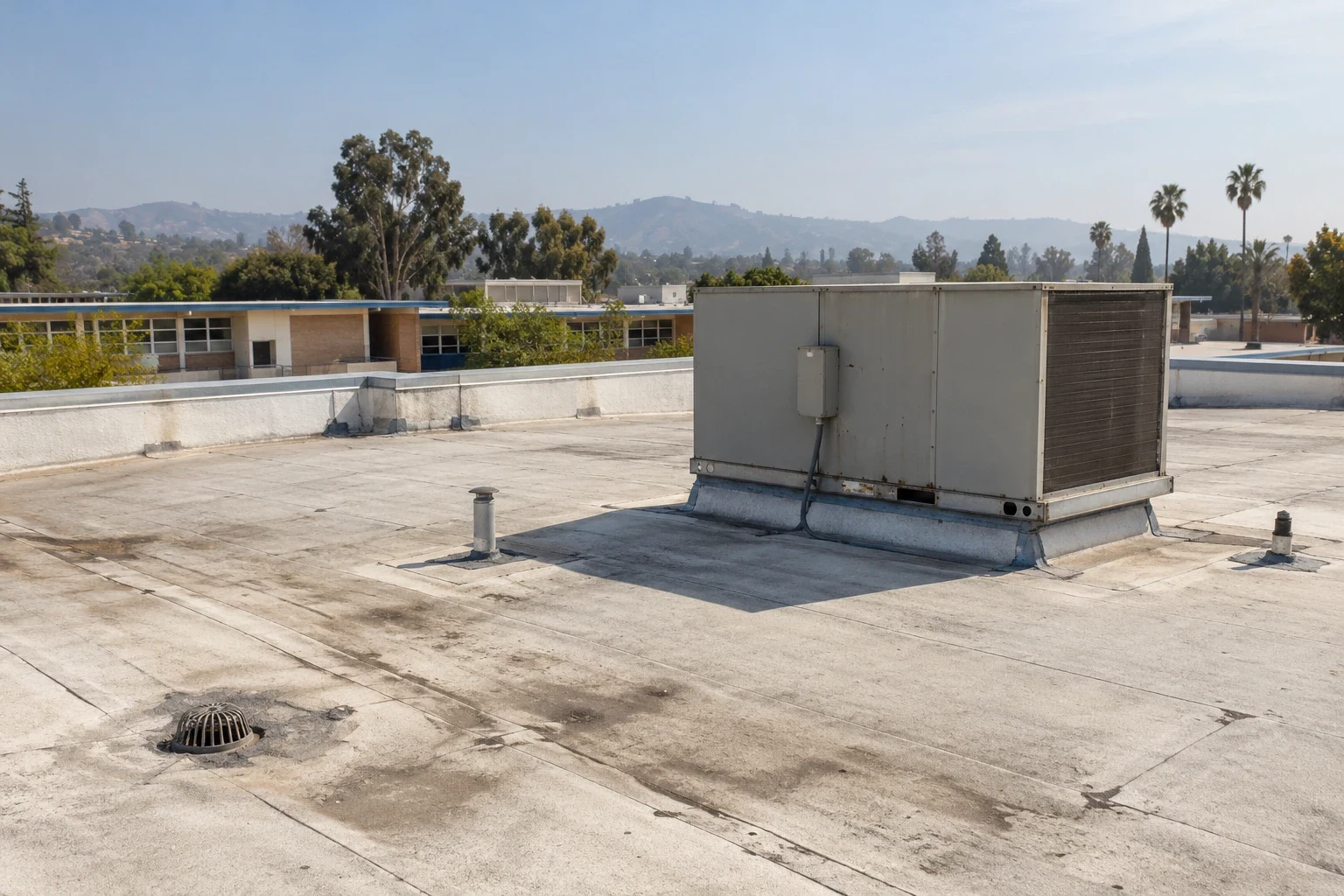
Showrooms, service areas, and connected support spaces may have different rooftop equipment and curb details. We verify how flashings meet the roof surface, inspect accessible seams and transitions, and note any movement, separation, or prior patch that warrants attention. Equipment curbs and penetrations should be coordinated with the owner’s mechanical contact if work could affect a unit or its service clearance.
Water management also needs a whole-system look. We check visible drains, scuppers, gutters, and discharge paths for conditions that may contribute to ponding or an interior leak. For a service-bay roof with equipment changes planned, the sequence should identify responsibility for temporary protection and final flashing at each handoff. Our equipment-curb coordination and drainage detail work can be scoped with the roof repair when warranted.
Daly City context: Confirm location and access
Daly City’s planning map divides the municipality into 13 areas. Its named districts include the Colma-Daly City BART station area and the commercial settings of Westlake, Serramonte, Mission Street, and Bayshore. Those place names help orient a project discussion, but they do not establish what roof assembly or site access a dealership has. We confirm the property’s actual roof plan, entry route, and drainage details before proposing a work boundary.
Retail, health services, and small enterprises are among the economic sectors Daly City calls out in its local profile. For a dealership, that context makes coordination with neighboring businesses and shared access worth discussing with the operator. Nearby business settings vary: San Francisco functions as a regional commercial center, while San Mateo’s named sectors include technology, financial services, restaurants, and retail. A dealership roof still calls for a site-specific review. When a group manages facilities in nearby cities, we set site-specific access and work windows rather than assume one location’s operating pattern fits the next.
Customer access during roof work on a dealership with a large retail footprint follows the same logic as shopping-center roof planning, and a parts or distribution building brings in the large-area questions of a warehouse roof. Each roof and work area still needs its own inspection.
Maintenance: Record repeat conditions
After a repair, the operator benefits from knowing what was addressed and what should be watched. We can document the roof areas reviewed, repairs completed, drainage observations, and any item deferred for later evaluation. That record supports a future inspection and helps staff distinguish a new symptom from a previously repaired detail.
At USW00023234 near San Francisco International Airport, NOAA’s annual precipitation normal is 19.64 inches, with 16.76 inches falling from November through March; this is station data, not a citywide Daly City measurement. In advance of the wetter period, a facility team can plan who checks drains and who receives reports of interior water. A preventive roof maintenance schedule makes those responsibilities and observations easier to track.
Questions About Auto Dealerships
Options: Compare the work on the same basis
When the owner is deciding between repair and replacement, consistent boundaries help. We identify the inspected areas, proposed tasks, access assumptions, protection measures, and exclusions. If concealed conditions could change the approach, the proposal should say how they will be recorded and brought back for approval before extra work is undertaken.
The existing assembly, substrate condition, drainage, prior repairs, and future plans for the property all matter. A coating or recover should not be assumed suitable without checking the roof beneath it. For a replacement project, the operator can compare phases by dealership zone and operating impact, while keeping tie-ins and temporary weather protection explicit. We present the findings so the team can ask focused questions before committing to a sequence.
Closeout: Return each work area to service
At the end of a work period, the crew and site contact should know whether the roof is secured, what temporary protection remains, and whether an entrance or vehicle route can reopen. On completion, we review the agreed roof area and provide a record of work performed and any follow-up items outside the approved scope.
For an initial visit, share the roof plan if available, leak locations, access restrictions, service and showroom hours, and the best contact for mechanical coordination. The Daly City commercial roofing team can discuss the inspection or repair step that fits the reported condition.
Commercial Roofing Questions
Can roof work take place while the dealership is open?
It may be possible when crew access, staging, and protection can be separated from customer and service traffic. We coordinate the schedule and any temporary route limits with the operator before work begins.
What should we do if a leak appears over a service bay?
Record the location and timing, protect the area below as appropriate, and share any recent repair history with the roofing team. An inspection can trace accessible roof details and define the repair scope.
Do rooftop mechanical units change the roofing scope?
They can affect access, flashing details, and coordination with the mechanical contractor. We note the visible curb conditions and clarify who handles equipment movement or service clearances before the roofing sequence is set.
Can a portfolio inspection cover several dealership locations?
Yes. The owner can request a coordinated review, with each facility’s findings recorded separately. We confirm access, operating hours, and roof information for each site rather than transfer assumptions between locations.
When should an owner evaluate replacement?
A broader evaluation may be useful when inspection documents recurring or widespread conditions. The existing assembly, drainage, repair history, and property plans guide the comparison; the findings should support the decision.
More Commercial Roofing in Daly City
Schedule a dealership roof review
Share the affected roof areas, operating hours, service-bay access needs, and any recent repair records. We will review the site conditions and outline a practical inspection or repair next step.